Texture & Material Transfer
The Texture & Material Transfer panel manages advanced PBR surface property inheritance, 3D contact UV rubber stamping, and dynamic texture reveals.
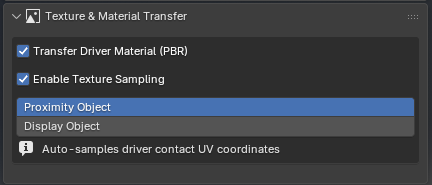
PBR Material Transfer
Reactive Surface FX is not limited to flat emissive colors. When Transfer Driver Material (PBR) (inherit_driver_material) is enabled, the display target dynamically inherits the full physical Principled BSDF surface properties of approaching drivers:
Metallic: If the driver is metallic (e.g. chrome, brushed steel, or polished gold), the activated display faces become reflective metallic mirrors.
Roughness: Contact faces inherit the driver’s microfacet roughness, transitioning smoothly from matte satin to high-gloss reflection upon contact.
Base Color: The diffuse base color channel transfers directly into the display’s active shader without requiring manual node wiring.
Popular Use Cases
Interactive Paintbrush: Touch a metallic gold sphere to a dull matte plaster wall to leave reflective golden streaks.
Wet Footsteps & Puddles: An invisible driver walking over asphalt can dynamically lower surface roughness to create reflective wet footprints.
Thermal Heat & Frost: Simulate heat signatures or frost crystallization by transferring frosty roughness and crystalline colors.
Texture Sampling Modes
When Enable Texture Sampling is checked, the engine unlocks UV-coordinate sampling for high-fidelity graphic transfer:
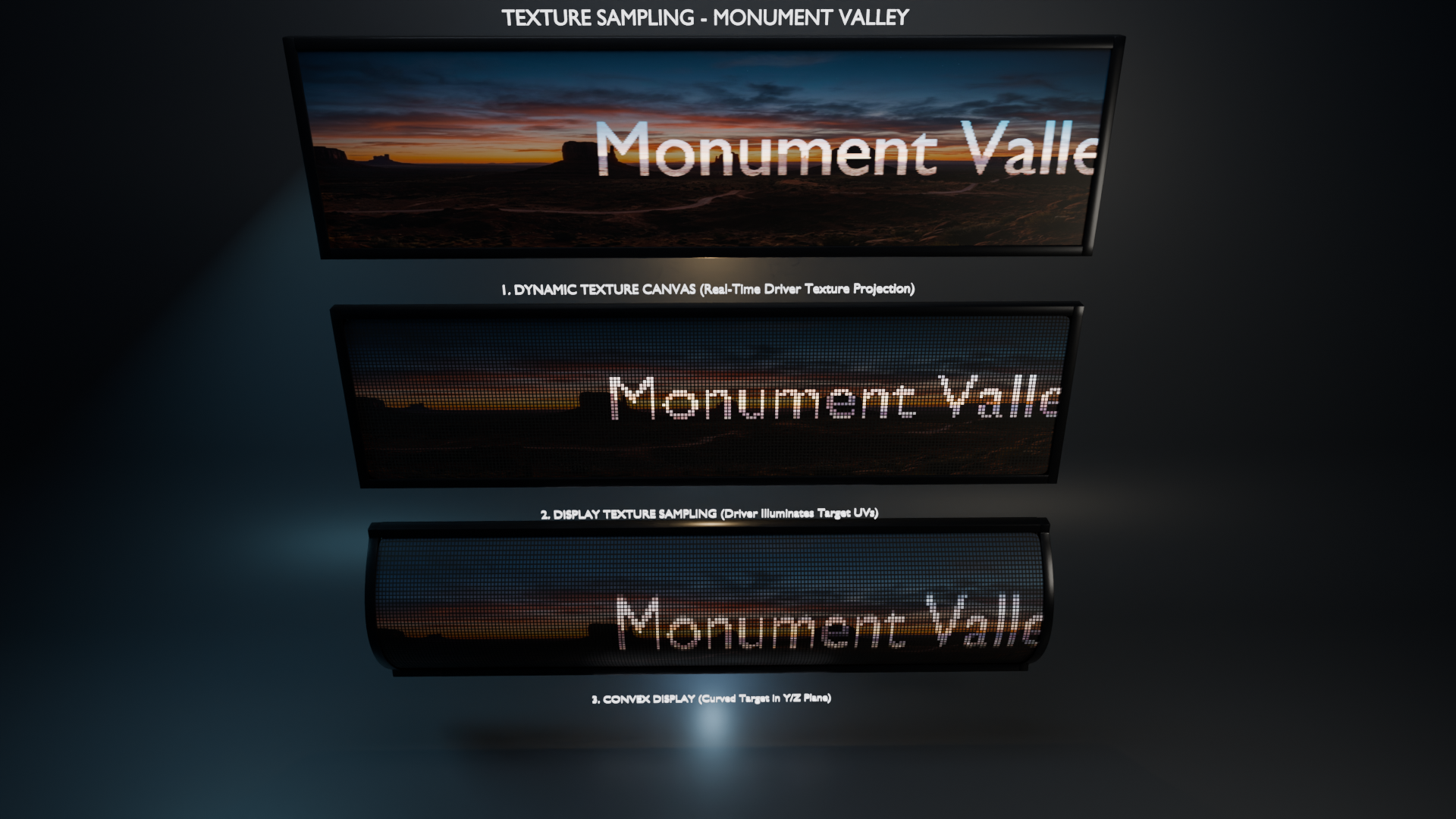
1. Proximity Object (3D Rubber Stamp Mode)
The engine evaluates the exact UV coordinate on the driver’s surface at the point of ray intersection, sampling that pixel and transferring it onto the display target.
Behavior: Moving a textured 3D object across the display behaves like a physical 3D rubber stamp, transferring complex patterns, logos, and graphics directly onto the receiving surface.
Example: Rolling an engraved, multi-colored cylinder across a planar canvas to stamp a pattern, or stamping a brand logo onto a curved vehicle chassis.
2. Display Object (Texture Reveal Mode)
The display target mesh has its own pre-assigned UV image (such as an artwork or graphic illustration assigned to Display Image).
Behavior: Dormant pixels remain completely black. As an invisible or visible driver sweeps across the surface, it reveals the underlying artwork wherever proximity is detected.
Example: An interactive flashlight beam revealing hidden ancient murals or glowing futuristic blueprints in a dark room.